Daud Khattak
By Daud Khattak
January 17, 2019
The Taliban’s Delusion Hampers Reconciliation
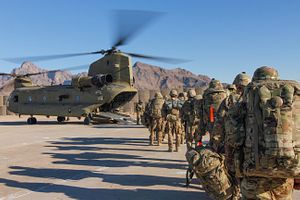
Credit: 1st Lt. Verniccia Ford

ADVERTISEMENTnull
ADVERTISEMENTnull
ADVERTISEMENTnull
long shared border, Iran has a somewhat complicated relationship with Afghanistan. Revolutionary Iran’s tumultuous birth coincided with the Soviet Union’s invasion of Afghanistan some four decades ago. Since then, Iran’s attempts to preserve its interests in conflict-ridden Afghanistan have not received much attention from the outside world, but it remains one of the most important neighboring countries for Tehran’s foreign policy.
Iran is an ambitious regional player with a clear understanding of its complex surroundings and a cautious plan to chart a path through them. The complicated nature of Iran’s relations with Afghanistan is in part a result of the fluctuating pattern of its interactions with the relevant stakeholders, which are meditated by the interplay of many identity or interest groups and intermediaries that have the potential for influencing social, political, and economic developments in what is a deeply contested society. More often than not, these groups and intermediaries have conflicting positions in Afghan society.
Another part of Iran’s complicated ties with Afghanistan can be attributed to its unremitting opposition to the United States, which is a strong partner of the Kabul regime. As a Shi’a-dominant country, Iran had a long history of ideological differences and political rivalry with the Afghan Taliban. During the ill-fated Taliban regime in the late 1990s, Iran supported the anti-Taliban Northern Alliance, a non-Pashtun coalition of other ethnic groups. Although Iran held back-channel diplomatic talks with the U.S. following the terrorist attacks of Sept. 11, 2001 on how to stabilize Afghanistan and eliminate al-Qaeda, several structural barriers prevented the informal talks from being institutionalized.
At present, an important dimension of Iran’s understanding of the Afghan crisis is related to how it perceives its relations with Washington. For a long time now, Tehran has been pursuing a risky policy of “hedging” in Afghanistan — simultaneously providing support to the Afghan government and the Taliban in the hopes of keeping them divided and influencing political developments once the U.S. draws down its forces. Due to this seemingly contradictory dual policy — one ambivalent and one conciliatory, one overt and one covert — it is difficult to analyze Iran’s intentions and influence in Afghanistan.
Tehran and the Taliban
There have been many reports of tactical understandings between Tehran and the Taliban. This stands in sharp contrast to the era of the Taliban regime, which received patronage from Saudi Arabia, Iran’s arch rival. However, in the post-9/11 world order, old attitudes changed as new geopolitical realities emerged. One such change was Saudi-Taliban ties, as it became hard for the Saudis to favor the Taliban at the cost of its traditional ally, the U.S. In recent years, Saudi Arabia’s harsh stance against Qatar, where the Taliban maintains its political office, and Qatar’s improved relations with Tehran have helped Iran and the Taliban become closer. This explains Iran’s ability and willingness to play different roles depending on the context and changing circumstances.
Afghanistan’s Shi’a Hazaras, who reside in the Koh-i-Baba Mountains on the western fringe of the Hindu Kush range in central Afghanistan, have deep socio-cultural bonds with Iran. During the years of the Afghan civil war, many Hazaras looked to Tehran as a counterweight to the Sunni Taliban. Iran also hosts millions of Hazara refugees who fled the miserable conditions in Afghanistan for a better life. There have been confirmed reports of Tehran dispatching young Hazaras to fight on behalf of the Assad regime in Syria as part of the Fatemiyoun Division, motivated by promises of money and permanent residency in Iran.
Despite being historically anti-Taliban, Tehran seems to have changed its tune on the understanding that the Taliban would no longer persecute Shi’a Hazaras. The Taliban has also reciprocated, and the reason seems tactical. Ahead of the intra-Afghan talks, the Taliban has pulled out all the stops to gain legitimacy among Afghan Hazaras. For instance, the Taliban’s newly appointed northern district governor, Mawlawi Mahdi Mujahid, is an ethnic Hazara Shi’a cleric. In a recent video message, Mujahid asked his co-religionists to fight against the “Jewish and Christian invaders.” He said, “Weren’t you holding our flags alongside the Sunni brothers in jihad against [the] Soviets? How can you forget that history? Why are you silent against these invaders led by the Americans?” Clearly, Mujahid’s utterances and political messaging are in tune with the Taliban’s anti-Western narrative.
It is also perhaps the first time the Taliban

